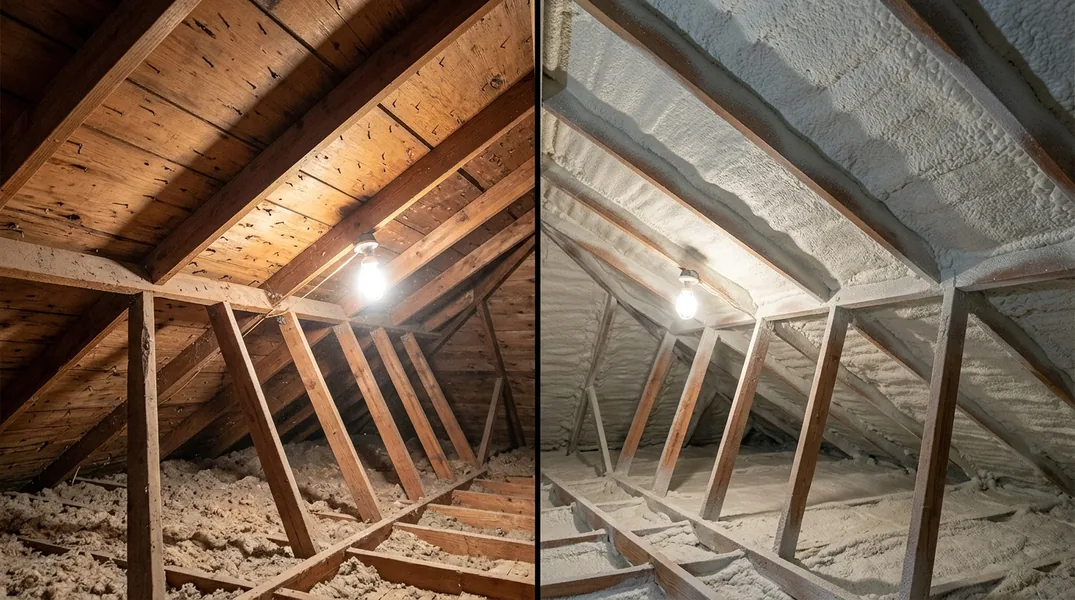
The Energy Crisis in Leon Valley's Mid-Century Ranches
If you own a mid-century ranch home in Leon Valley, you're living in a piece of San Antonio history. These charming, single-story homes defined suburban living from the 1950s through the 1970s, with their clean lines, open floor plans, and affordable construction. But here's the problem: most of them were built with insulation standards that are now decades outdated.
The typical mid-century ranch relies on fiberglass batts, loose-fill cellulose, or sometimes nothing at all in the attic. These materials worked fine in an era before air conditioning became universal and energy costs were negligible. Today, homeowners in Leon Valley face brutal summer heat that makes inefficient attics a serious liability. Your cooling system works overtime, your energy bills spike, and your home never quite reaches a comfortable temperature, no matter how hard your AC runs. The culprit is simple: outdated insulation that doesn't seal air leaks or provide adequate thermal resistance.
Spray Foam vs. Blown-In Insulation: Why Your Attic Needs Better Protection
When it comes to choosing the best insulation for attic spaces, homeowners often compare spray foam vs blown in insulation without fully understanding the critical differences. Blown-in insulation, whether cellulose or fiberglass, works by filling cavities with loose material. It's affordable and relatively quick to install, which is why many contractors default to it. However, blown-in insulation has a fundamental weakness: it doesn't seal air leaks. Gaps around electrical outlets, pipes, ductwork, and framing cavities allow conditioned air to escape, undermining the material's R-value and forcing your HVAC system to compensate.
Spray foam, by contrast, expands as it's applied and hardens into a solid, airtight barrier. When you choose spray foam vs blown in insulation, you're choosing a solution that seals every crack, crevice, and gap while simultaneously providing insulation. In the Texas heat, this air-sealing capability is invaluable. A properly installed spray foam attic doesn't just insulate; it creates a thermal envelope that keeps cool air inside and hot air out. For mid-century ranches in Leon Valley with irregular framing, settling foundations, and decades of small gaps, spray foam delivers measurable energy savings that blown-in materials simply cannot match.
Spray Foam vs. Fiberglass: Understanding the Upgrade Path
Your ranch likely has fiberglass batts installed between the attic joists. Fiberglass was the standard for decades and remains popular because it's inexpensive and easy for DIYers to handle. But spray foam vs fiberglass is not a close comparison when you examine real-world performance. Fiberglass batts have an R-value of roughly 3.2 to 3.8 per inch, which sounds adequate on paper. In practice, however, fiberglass batts are notorious for settling over time, especially in attics that experience temperature fluctuations. Moisture intrusion, common in older homes, also degrades fiberglass performance. Additionally, fiberglass does nothing to address air leakage, which accounts for a significant portion of energy loss in attics.
Spray foam provides superior air sealing and maintains its R-value indefinitely. Closed-cell spray foam offers an R-value of 6 to 7 per inch, nearly double that of fiberglass. Open-cell spray foam delivers around 3.6 per inch but with exceptional air-sealing properties and moisture management. When you compare spray foam vs fiberglass in a hot climate like San Antonio's, the energy efficiency gains are substantial. Homeowners typically report 15 to 30 percent reductions in cooling costs after upgrading from fiberglass to spray foam, a return on investment that fiberglass cannot deliver.
Spray Foam vs. Cellulose: Which Material Truly Performs Best
Cellulose is another popular blown-in option, made from recycled paper and treated with fire retardants. It's eco-friendly and slightly more effective than fiberglass at air sealing due to its denser composition. However, spray foam vs cellulose reveals important trade-offs. Cellulose is hygroscopic, meaning it absorbs and releases moisture. In humid climates or in attics with roof leaks, cellulose can retain water, promoting mold growth and structural rot. It also settles significantly over time, losing R-value as it compacts. Like other blown-in materials, cellulose requires careful installation to avoid voids and gaps that compromise performance.
Spray foam, particularly Closed Cell Spray Foam Insulation, resists moisture intrusion and never settles. It creates a vapor barrier that protects your home's structure from humidity and condensation. For mid-century ranches in Leon Valley with aging roofs or poorly ventilated attics, this moisture resistance is critical. Spray foam vs cellulose becomes a clear choice when you consider durability: spray foam lasts 30 to 40 years or more with zero degradation, while cellulose typically needs refreshing every 15 to 20 years. The upfront cost difference narrows significantly when you factor in replacement cycles.
Wall & Injection Foam Insulation: Upgrading Beyond the Attic
Many homeowners focus exclusively on attic insulation and overlook the walls, where energy loss is equally significant. Mid-century ranches often have hollow walls with little to no insulation, a major weakness in the Texas heat. Wall & Injection Foam Insulation is a game-changer for these homes because it allows you to insulate existing walls without tearing them apart. Injection foam is injected into cavities through small holes drilled in the exterior or interior, then expands to fill the entire cavity. This method works beautifully for ranch homes where opening walls isn't practical or affordable.
The combination of attic spray foam and wall injection foam creates a comprehensive thermal upgrade that transforms your home's energy performance. Older ranches lose heat through walls in winter and gain heat through walls in summer. Sealing and insulating these cavities reduces the workload on your HVAC system year-round. For homeowners in San Antonio looking to maximize comfort and minimize energy costs, a whole-home spray foam strategy delivers results that piecemeal upgrades cannot match.
Attic Spray Foam Insulation Cost in Leon Valley: What to Budget
The investment in Attic Spray Foam Insulation varies based on your attic size, existing insulation, and the type of spray foam you choose. Open-cell spray foam is generally less expensive than closed-cell, though closed-cell delivers superior R-value and moisture resistance. For a typical mid-century ranch attic in Leon Valley, you can expect the project to range from $1,500 to $4,000 or more, depending on square footage and complexity. While this is higher than blown-in insulation, the energy savings and longevity make it a smart investment. Many homeowners recover their investment within five to seven years through reduced cooling and heating costs.
San Antonio Spray Foam Insulation offers transparent pricing and a free estimate process so you understand costs before work begins. We recommend getting multiple quotes to compare, but remember that the cheapest option isn't always the best. A professional installation with quality materials and proper technique ensures your spray foam performs as designed for decades. Call us at (830) 429-5826 to discuss your project and receive a detailed quote tailored to your home's specific needs.
Next Steps: Scheduling Your Attic Spray Foam Insulation Near Me
If you're ready to stop losing energy and money through an inefficient attic, the next step is a professional assessment. San Antonio Spray Foam Insulation serves Leon Valley and the surrounding area with expert installation and customer-focused service. We'll evaluate your current insulation, identify air leaks, and recommend the best solution for your mid-century ranch. Whether you choose closed-cell or open-cell spray foam, our team ensures proper installation that delivers measurable results.
Don't let another summer pass with your AC running constantly and your energy bills climbing. Contact San Antonio Spray Foam Insulation today at (830) 429-5826 or visit our website to request a free estimate. We're committed to helping homeowners in Leon Valley and San Antonio achieve the comfort and efficiency their homes deserve.
Looking for a professional spray foam insulation contractor in San Antonio? San Antonio Spray Foam Insulation responds fast for all your spray foam insulation needs.
Get a Free Quote