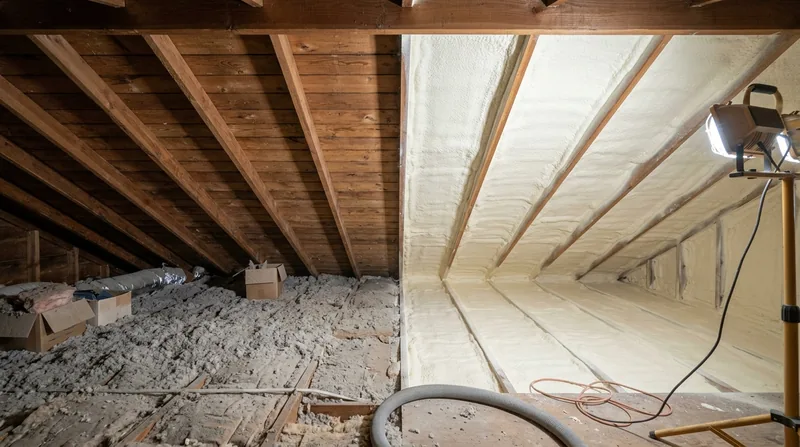




San Antonio's long cooling season and vented attic design create a punishing environment for old insulation. The combination of extreme summer heat, humid air infiltration through leaky envelopes, and ductwork running through uncontrolled attic spaces means that insulation installed 15 or 20 years ago has settled, compressed, or degraded to a fraction of its original R-value. Mid-century ranches across Leon Valley, Alamo Heights, and the inner neighborhoods often carry thin fiberglass batts in wall cavities that never matched the climate load. Pier-and-beam homes in Monte Vista and King William expose crawl spaces and rim joists to ground moisture and unconditioned air. When cooling costs climb and rooms stay hot despite the thermostat, insulation replacement and re-insulation is often the answer. We remove failed material and install new spray foam sized to the job, with the R-value and thickness specified in writing before work begins.
Why Insulation Replacement and Re-Insulation Matters in San Antonio's Climate
Old insulation fails quietly. Fiberglass batts settle under gravity and moisture exposure, losing 20 to 30 percent of their rated value within the first decade. Blown-in cellulose and fiberglass compact over time, especially in humid climates like ours where moisture wicks in from outside during the long cooling season. Spray foam that was improperly installed, applied too thin, or left uncured in high humidity can fail to seal and may even off-gas if the installation was rushed. The result is higher cooling loads, uneven room temperatures, and energy bills that don't match what your HVAC system should be delivering.
- Old fiberglass and blown insulation settle and lose R-value, especially in vented attics exposed to 130-degree temperatures.
- Failed spray foam installations leave gaps and air leaks that undermine the whole thermal envelope.
- Settled insulation in wall cavities of mid-century ranches reduces cooling efficiency by 15 to 25 percent.
- Moisture-damaged insulation in crawl spaces and rim joists invites mold and structural decay.
- Replacing worn material with new spray foam stops the air leaks and restores the thermal barrier.
Replacing failed insulation is not a luxury upgrade. It is the foundation of an efficient home envelope, and in San Antonio's 120-plus-day cooling season, it pays for itself through lower bills and more consistent comfort.
Key info: A home in Leon Valley with an uninsulated or poorly insulated attic can see cooling costs rise 30 to 40 percent compared to a properly sealed and insulated space. Replacement with closed-cell foam stops both heat gain and humidity infiltration, the two drivers of summer cooling loads in Central Texas.
For guidance on what your city or county requires before any insulation work begins, contact your local building department. Many cities in Greater San Antonio require contractor registration and a permit for insulation replacement, especially if you are removing old material. Ask any contractor, including us, to show proof of registration with your city or county before work starts.
How Insulation Replacement and Re-Insulation Works in San Antonio Homes
The process begins with a walkthrough and honest assessment. We identify what is in place, measure thickness and coverage, and explain what is failing and why. Some jobs call for complete removal of old material, especially if it is wet, contaminated, or so settled that leaving it in place would undermine the new foam. Other jobs allow us to leave stable material in place and add new foam on top or in gaps. We always specify the R-value and thickness we will install, in writing, before we start. The work includes air sealing around penetrations, rim joists, and band joists, because insulation without air sealing is like a sieve. We install mechanical ventilation during the cure period and respect a 24 to 48-hour re-entry window before the space is occupied.
- We inspect the existing insulation and identify settled, wet, or contaminated material that must be removed.
- We remove old insulation, debris, and obstructions from attic floors, crawl spaces, and wall cavities.
- We seal air leaks at rim joists, band joists, ductwork penetrations, and roof-wall intersections before spraying new foam.
- We apply new spray foam at the specified thickness and R-value, documented in a written estimate.
- We install mechanical ventilation during cure and confirm re-entry timing with the homeowner.
- We clean up debris and leave the space ready for normal use after the cure window closes.
The job is complete when the new insulation is in place, sealed, and cured. You will notice the difference immediately: cooler rooms, steadier thermostat readings, and lower energy bills within the first month of cooling season.
Example: A home in Castle Hills with a 1,200-square-foot attic and settled fiberglass batts at R-11 or less typically receives a replacement with 5.5 inches of closed-cell foam (R-37 to R-40) plus air sealing at the roof deck, rim joists, and ductwork. The job takes 1 to 2 days and includes removal of old material, ventilation during cure, and a written thermal barrier certification. Learn more about attic spray foam insulation and how it compares to other methods.
Insulation Replacement Methods and Materials
| Approach | Description | Best for |
|---|---|---|
| Complete Removal and Closed-Cell Foam | Strip the attic or crawl space down to the deck, remove all old material, then apply closed-cell spray foam at 5 to 6 inches for maximum R-value and air sealing. | Vented attics with failed insulation, crawl spaces with moisture issues, homes in San Antonio with high cooling loads. |
| Partial Removal and Top-Up Foam | Remove settled or wet material from critical areas (rim joists, band joists, ductwork), then apply open-cell or closed-cell foam to fill gaps and seal air leaks while leaving stable material in place. | Mid-century ranches with mixed insulation, attics where some batts are still sound, budget-conscious retrofits. |
| Wall and Injection Foam Retrofit | Drill small holes in exterior or interior walls and inject low-pressure foam into closed cavities without demolition. Restores R-value to pre-1980 wall assemblies. | Older homes in Monte Vista, King William, and Alamo Heights with thin or missing wall insulation. |
| Rim Joist and Band Joist Sealing | Spray closed-cell foam around the rim and band joists of pier-and-beam homes to seal the crawl space interface and stop air infiltration. | Pier-and-beam homes in Monte Vista, King William, and Leon Valley where crawl space air leaks drive cooling losses. |
Each approach is priced and specified on site. We do not apply spray foam over wet, contaminated, or actively leaking substrates. If a roof leak, plumbing failure, or moisture intrusion is present, we identify it and put the foam work on hold until the right trade has fixed it. The foam goes down only when the substrate is dry and stable.
Insulation Replacement and Re-Insulation Cost in San Antonio: What to Expect
Cost depends on the scope of removal, the square footage being insulated, the R-value and thickness you choose, and the complexity of the space. A straightforward attic replacement in a 1,200-square-foot space with complete removal and closed-cell foam typically starts around $2,800 and moves up based on access difficulty, ductwork in the way, or the need for rim joist and band joist sealing. Wall injection foam retrofit costs are priced per linear foot of wall cavity. Crawl space jobs are priced by square footage and the depth of the space. The best way to understand cost for your home is to get a written estimate with R-value, thickness, and the square footage or board-foot total specified. We provide free estimates within 24 hours. Call (830) 429-5826 or visit our pricing page for a realistic breakdown of what different scopes cost in San Antonio.
Do not compare spray foam pricing to fiberglass or blown-in quotes without understanding the difference. Spray foam seals air leaks as it insulates, which fiberglass does not do. The higher upfront cost is offset by lower cooling bills and more consistent comfort. Get 2 or 3 estimates before you decide. Ask each contractor for a written specification of R-value, thickness, and total board feet or square footage. Be skeptical of any estimate that omits these details or promises a price per square foot with no mention of what will actually be installed.
What to Look for When Hiring an Insulation Replacement Contractor Near San Antonio
The spray foam trade attracts both legitimate local shops and rig-and-run crews that spray in an afternoon and vanish when the smell will not go away or the foam cracks and pulls from the substrate. The difference is in technique, accountability, and honesty. A professional contractor will walk your space before quoting, explain what is failing and why, offer options at different price points, provide a written estimate with R-value and thickness, and stand behind the work with a warranty. They will also confirm what permits and registrations your city or county requires before starting, and ask you to verify their credentials. Ask for references from recent jobs in San Antonio, Leon Valley, or Alamo Heights. Call those homeowners and ask if the job stayed on schedule, if the smell was managed during cure, and if the contractor was reachable after the work was done.
- Verify that the contractor is fully insured and can provide a certificate of insurance before work begins.
- Ask your city or county building department what contractor registration or licensing is required at your address, and confirm the contractor holds it.
- Request a written estimate with the R-value, thickness, and total square footage or board feet of foam to be installed.
- Ask about the cure process, mechanical ventilation during application, and the re-entry window before you occupy the space.
- Check references from at least two recent jobs in your area and ask about post-job communication and warranty terms.
- If your home is in an HOA, confirm that exterior work on metal buildings or rim joists does not violate architectural rules before signing a contract.
The best insulation contractor is the one who answers your questions directly, admits what they don't know, and refers you to a licensed specialist when the job requires it. If a contractor promises mold remediation, rodent decontamination, or crawl space encapsulation as part of an insulation job, walk away. Each of those is a separate trade with its own licensing and liability. Contact us at our contact page to request a free estimate and ask any questions about how we approach insulation replacement in your home.
Insulation Replacement & Re-Insulation in San Antonio: Pricing Guide
| Service | Price | Details |
|---|---|---|
| Attic insulation replacement (complete removal and closed-cell foam) | Starting at $2,800 | 1,000 to 1,500 sq ft attic, 5 to 6 inches closed-cell foam, includes removal and air sealing |
| Wall injection foam retrofit (closed-wall cavities) | Starting at $1,200 | Typical 500 to 800 linear feet of wall cavity, low-pressure injection foam, no demolition required |
| Crawl space and rim joist sealing | Starting at $1,600 | 500 to 800 sq ft crawl space or pier-and-beam perimeter, closed-cell foam, includes moisture assessment |
| Large-scale or complex replacement (multiple zones) | On estimate | Attic plus crawl space, metal building, or barndominium insulation requires site inspection for accurate pricing |
| Travel and estimate | Included and free | No mileage fee within San Antonio and surrounding Bexar County service areas, estimate response within 24 hours |
Indicative pricing, the exact cost depends on square footage, finish, and site access. Free personalized estimate within 24h at (830) 429-5826.


