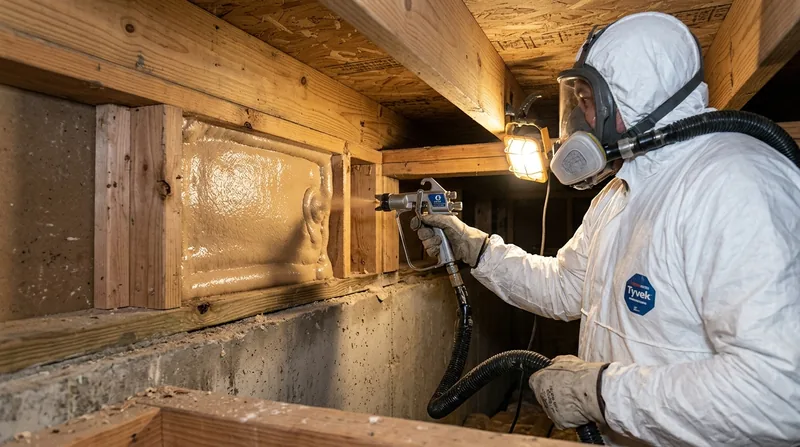




Closed cell spray foam insulation in San Antonio delivers rigid, moisture-resistant protection that stands up to the region's long humid cooling season and the stack effect that pulls outside air through older envelopes. San Antonio's housing stock spans pier-and-beam bungalows in Monte Vista and King William, mid-century ranches across Leon Valley and the inner neighborhoods, and sprawling subdivisions pushing north toward Stone Oak and Helotes, most sitting on slab-on-grade foundations. Vented attics bake under Central Texas summer heat and pull in humid air that works against your HVAC system below, while wall cavities in older homes often carry thin or settled insulation that never matched the load. Closed cell foam adds the density and air-sealing performance that this climate demands, especially in rim joists, exterior walls, and additions where moisture ingress and thermal bridging drive energy loss year-round. We've been insulating San Antonio homes and commercial buildings since 2009, and we size every job to the actual conditions on your property.
Why Closed Cell Spray Foam Matters in San Antonio's Hot and Humid Climate
San Antonio sits in IECC climate zone 2A, hot and humid, which means moisture moves inward through walls and roof decks for much of the year, not outward. Vented attics pull humid air up through the floor, and older rim joists on pier-and-beam homes sit exposed to ground moisture and temperature swings that degrade fiberglass and settle blown-in insulation over time. Closed cell foam stops that air movement, resists moisture absorption, and holds its R-value for decades without settling or compression. It is denser than open cell foam, adds structural rigidity to rim joists and band joists, and works especially well in slab-on-grade additions and metal buildings where condensation control is the primary failure mode.
- Stops air infiltration and exfiltration that fiberglass and blown-in cannot seal.
- Resists moisture absorption in humid climates and in direct contact with concrete or soil.
- Holds R-value over time without settling, compression, or thermal drift.
- Adds rigidity to rim joists, band joists, and metal building walls under wind and pressure loads.
- Works well in retrofit applications where walls cannot be opened and cavities are irregular.
These properties make closed cell the right choice when air sealing and moisture resistance are the primary drivers of your energy loss or comfort problem.
Key info: Closed cell foam in a Monte Vista bungalow's rim joist stops the draft that pulls humid outside air into the crawl space below the living floor, cutting the stack effect that works against your air conditioning all summer long. A slab-on-grade addition in Alamo Heights sealed with closed cell stops condensation on the concrete edge and holds indoor temperature stability without the thermal bridging that undermines open cell or fiberglass in the same application.
For more detail on how spray foam compares to other approaches in attics, see our guide to attic spray foam insulation in San Antonio.
How We Install Closed Cell Spray Foam in San Antonio Homes and Buildings
Closed cell foam is sprayed as a liquid and expands to fill cavities, cracks, and irregular spaces in a single pass. The application requires precision in equipment calibration, drum temperature, mixing ratio, and spray distance to hit the target thickness and density. We bring the substrate to the right moisture level, control the ambient temperature during application and cure, and run mechanical ventilation for the full cure window, typically twenty-four to forty-eight hours. After cure, the foam is rigid, non-settling, and ready for any finishing work your project requires.
- We assess the substrate, measure the cavity or surface, and confirm no active moisture or leaks are present.
- We set up equipment on site, confirm drum temperature and mixing ratio match the manufacturer specification for your conditions.
- We spray the foam in controlled passes, building to the target thickness and density without over-packing or voids.
- We run mechanical ventilation and establish a re-entry window so the space is safe for occupancy and finishing work.
- We trim excess foam flush with the cavity and prepare the surface for drywall, plaster, or other finish as needed.
The result is an air-sealed, moisture-resistant thermal barrier that stays in place and performs for the life of the building.
Example: A Leon Valley mid-century ranch with a 1,200-square-foot attic over the main living area had settled fiberglass and active air leaks around the eaves and ductwork penetrations. We removed the old insulation, sealed all penetrations and rim details with closed cell foam, then topped the rim and perimeter with blown-in open cell for cost efficiency. The homeowner saw a 12-degree drop in peak attic temperature and measurable comfort improvement within the first summer. See our insulation removal page for details on how we handle old material safely and responsibly.
Closed Cell Spray Foam Applications and Methods in San Antonio
| Application | Description | Why Closed Cell Works Here |
|---|---|---|
| Rim and Band Joists | Insulating the exposed rim of pier-and-beam homes in Monte Vista, King William, and Alamo Heights, where ground moisture and temperature swings are constant. | Stops air infiltration, resists moisture, and adds structural rigidity to the rim assembly without compression or settling. |
| Exterior Walls and Retrofit Cavities | Filling settled or thin cavities in mid-century ranches and older homes without opening walls or removing siding. | Fills irregular spaces, seals air leaks, resists moisture ingress, and does not settle or compress over decades. |
| Slab-On-Grade Additions | Insulating the perimeter and rim of new additions and room expansions that sit on concrete slabs across San Antonio and surrounding areas. | Stops thermal bridging at the concrete edge, prevents condensation, and maintains interior temperature stability without moisture absorption. |
| Metal Buildings and Barndominiums | Spraying the underside of metal roof decks and walls in shops, garages, and residential conversions in Helotes, Converse, and Guadalupe County. | Closed cell adheres to steel, controls condensation on the metal surface, and provides continuous thermal and air-sealing protection without gaps. |
| Crawl Space Perimeter and Rim | Sealing the band joist and perimeter walls of crawl spaces under older homes and pier-and-beam additions. | Stops humid outside air from entering the crawl space, reduces the stack effect pulling air into the living space above, and resists moisture from ground contact. |
Each application is sized to the substrate condition, the local climate load, and the energy or comfort problem you are solving. We do not spray over wet, contaminated, or leaking substrates, and we walk away if the moisture or structural issue needs to be fixed first.
Closed Cell Spray Foam Insulation Cost in San Antonio: What to Expect
Closed cell spray foam in San Antonio typically costs starting at $1.20 per board foot, with most residential jobs ranging from $1.20 to $2.00 per board foot depending on substrate condition, accessibility, and the thickness and density required for your application. A 500-board-foot rim joist and band joist job on a Monte Vista bungalow might run $600 to $1,000 before any finishing work. A larger project like a sealed attic perimeter or a slab-on-grade addition can easily reach $2,000 to $4,000 or more, depending on square footage and the complexity of the substrate.
The biggest cost drivers are the size of the area being insulated, how accessible it is for our crew and equipment, the substrate condition and any prep work required, and whether you need finishing work like drywall or thermal barriers after the foam cures. We always provide a written estimate with the R-value, thickness, and board-foot count so you know exactly what you are paying for and can compare estimates fairly.
Getting two or three estimates from local contractors is the smart move. Look for estimates that include R-value, thickness in inches, and board-foot count, not just a lump sum or a price per square foot. Estimates missing those details are a red flag. We provide a free estimate within 24 hours, and there is no obligation to book. Call us at (830) 429-5826 or visit our full pricing page for more detail on what moves costs up or down for your specific situation.
Closed Cell Spray Foam Insulation Near Me: What San Antonio Homeowners Should Know When Hiring a Contractor
Hiring the right spray foam contractor is about more than price. You need someone who understands San Antonio's climate, the specific failure modes of your home's construction type, and the installation discipline required to avoid the smell, off-gassing, and performance issues that mark bad spray foam work. The spray foam trade includes both rig-and-run crews that spray a job in an afternoon and disappear, and national franchises with high overhead and little local accountability. The local independent contractor who knows the building stock, shows up for follow-up, and stands behind the work is the differentiator.
- Ask any contractor for proof of current insurance coverage and verify it is active, not just a certificate with no underwriter contact information.
- Request references from recent jobs in your neighborhood, not from jobs three years ago or in another state.
- Confirm the contractor understands what permits your city or county requires for your address and will help you navigate the process.
- Get at least two written estimates that include R-value, thickness in inches, and board-foot count, never just a price per square foot or a lump sum.
- Ask about the cure time, re-entry window, and mechanical ventilation during application, and be skeptical of anyone promising immediate occupancy.
- Understand that HOA rules in master-planned areas may restrict exterior work on metal buildings or additions, so confirm your project is approved before any contractor commits.
We are fully insured, we provide written estimates with R-value and thickness specs, and we have been insulating San Antonio homes and buildings since 2009. Call us at (830) 429-5826 for a free, no-obligation estimate, or contact us online and we will reach out within 24 hours.
Closed Cell Spray Foam Insulation in San Antonio: Pricing Guide
| Service | Price | Details |
|---|---|---|
| Rim Joist and Band Joist Sealing | Starting at $1.20/board ft | Typical 300 to 600 board feet for a 1,200 to 1,800 sq ft home on pier-and-beam foundation, includes prep and mechanical ventilation during cure |
| Exterior Wall Retrofit and Injection Foam | Starting at $1.50/board ft | Cost varies with cavity depth, wall height, and accessibility; settled or thin insulation removal adds labor but improves final performance |
| Slab-On-Grade Addition and Perimeter Sealing | Starting at $1.20/board ft | Typical 200 to 400 board feet for a 400 to 600 sq ft addition, includes rim joist and concrete edge thermal break |
| Metal Building and Barndominium Roof Deck | Starting at $1.50/board ft | Larger projects with open spans; substrate prep and steel adhesion confirmation add to final cost but are essential for condensation control |
| Complex or Large-Scale Job | On estimate | Whole-attic sealing, multi-building commercial projects, or substrates with moisture or contamination require on-site inspection before pricing |
| Estimate | Free | Response within 24 hours at (830) 429-5826, written estimate includes R-value, thickness, and board-foot count, no obligation to book |
Indicative pricing, the exact cost depends on square footage, finish, and site access. Free personalized estimate within 24h at (830) 429-5826.


