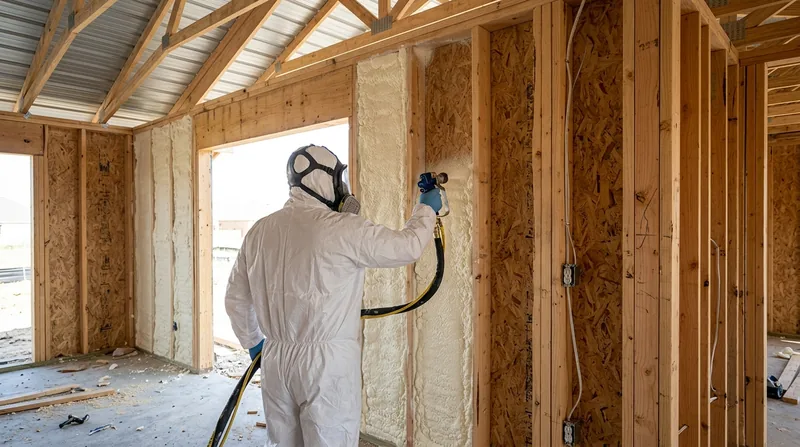




Commercial & New Construction Spray Foam in San Antonio is not an afterthought, it is a planning requirement that sits in the critical path between framing and drywall. San Antonio's sprawling master-planned subdivisions north of Stone Oak, the dense infill across the inner city, and the growing commercial corridors in Converse and Helotes all demand envelope work that meets schedule and code before the wall goes closed. Our work with builders on new construction attics, sealed roof decks, wall cavities, and metal shells across Bexar and Comal counties ensures that insulation is installed to specification before any other trade is locked in. The long Central Texas cooling season and the stack effect that pulls humid outside air through an undersized or poorly sealed envelope make the difference between a tight building and a leaky one a matter of dollars per month over the life of the structure. We handle the planning, the installation, and the coordination that keeps your project on time.
Why Commercial & New Construction Insulation Planning Matters in San Antonio
San Antonio builders face a unique envelope challenge. The climate zone here is 2A, hot and humid, which means moisture drives inward through walls and roof decks for much of the year, not outward. A vented attic or a wall cavity with insufficient air sealing will pull humid outside air all summer long and work directly against the HVAC system below. Sealed attics, properly installed closed cell or open cell foam in walls, and controlled air sealing around rim joists and band joists are not luxuries; they are the baseline for a building that does not leak energy or moisture. New construction gives you the chance to get it right the first time, before settlement, before retrofit costs, before the complaints start.
- We plan spray foam placement before framing is complete so that no structural member is missed and no schedule conflict arises.
- We coordinate with your builder's timeline and pull any required permits so that the work fits between the structural inspection and drywall delivery.
- We install to R-value and thickness specifications, documented on every estimate, so that your building meets code and your warranty is clear.
- We manage air sealing around penetrations, rim joists, and band joists so that the envelope is continuous and the stack effect is controlled.
- We work with both traditional attic applications and sealed roof decks, adapting the foam type and placement to your building's specific design.
The result is a building that holds its conditioned air, resists the moisture drive that dominates San Antonio summers, and performs as designed from day one.
Key info: San Antonio's building code is adopted from the International Energy Conservation Code (IECC), enforced by the local building department in your city or county. Attic ventilation, ignition barriers, and thermal barrier requirements vary by jurisdiction, so we confirm what applies at your address before any estimate is written. Ask your builder or the building official whether your project requires a fifteen-minute thermal barrier, a ignition barrier, or both. That distinction alone separates contractors who understand the code from those who guess.
For current code requirements and permitting guidance specific to your project location, contact your local building department or visit the International Code Council website for resources on energy code adoption in Texas.
How We Plan and Install Commercial & New Construction Spray Foam in San Antonio
Commercial and new construction projects move fast. We work backward from your drywall delivery date to schedule the insulation spray, ensuring that foam is applied at the right stage, after structural inspection, before mechanical rough-in if possible, and always with enough time for cure before the next trade arrives. Our process starts with a detailed walk-through of the building plans, a site visit to confirm dimensions and substrate conditions, and a written estimate that specifies R-value, foam thickness, and the coverage area. We identify air sealing points, rim joists, band joists, roof penetrations, and ductwork chases, and include them in the scope so that the thermal envelope is complete.
- We review your building plans and confirm the intended foam type, R-value target, and any code-specific barrier requirements with the general contractor and the building official.
- We conduct a site visit to measure the attic, sealed roof deck, wall cavities, or metal building shell and to verify substrate condition and access for equipment.
- We provide a written estimate that names the R-value and thickness for each application area, the square footage, and the total board feet required.
- We schedule the spray to align with your framing inspection and your drywall delivery, minimizing delays and keeping the project on track.
- We set up mechanical ventilation during cure and confirm a re-entry window of twenty-four to forty-eight hours before drywall installation begins.
- We document the installation with photographs and a completion record that is yours to keep for warranty and code compliance.
This approach eliminates guesswork and keeps your project moving on schedule while ensuring that every square foot meets the specification you paid for.
Example: A new construction subdivision in Helotes with thirty homes scheduled for drywall in eight weeks. We coordinate with the general contractor to spray attics and sealed roof decks in two phases, timing the work between framing inspection and mechanical rough-in. Each home is documented with thickness measurements and R-value confirmation so that the builder has a record for the homeowner and the code official. Total project time: two weeks of spraying, zero schedule conflicts.
For more detail on how we manage air sealing around critical points in new construction, see our air sealing service page.
Spray Foam Methods for Commercial & New Construction in San Antonio
| Approach | Description | Best for |
|---|---|---|
| Closed Cell Spray Foam | High-density foam that creates a vapor barrier and air seal in a single application. R-value of approximately 6 to 7 per inch. Resists moisture and provides structural support to the roof deck. | Sealed roof decks, metal building shells, rim and band joists, and any application where moisture control and air sealing are critical. |
| Open Cell Spray Foam | Lower-density foam that allows vapor transmission and provides excellent sound dampening. R-value of approximately 3.5 to 4 per inch. Requires a separate vapor barrier or interior finish. | Attics in new construction where sound control is desired, wall cavities in buildings with good ventilation, and applications where cost is a priority. |
| Wall & Cavity Injection Foam | Closed cell foam injected into existing wall cavities or new construction wall framing before drywall is hung. Fills voids completely and adds structural rigidity to the wall assembly. | New construction walls, retrofit applications where the wall is still open, and any cavity where uniform insulation and air sealing are required. |
| Metal Building & Sealed Roof Deck Insulation | Closed cell foam sprayed directly to the inside of metal roof panels or structural decking, creating a continuous thermal and moisture barrier. Prevents condensation on cold metal surfaces. | New metal buildings, barndominiums, commercial shells, and any structure where condensation on steel is a risk and thermal performance is essential. |
Commercial & New Construction Spray Foam Cost in San Antonio: What to Expect
The cost of spray foam insulation for new construction and commercial projects depends on the building size, the foam type, the R-value target, and the complexity of the application. A sealed attic in a single-family home might require two hundred to four hundred board feet of foam, while a metal building or a multi-unit commercial shell can run several thousand board feet. We provide a free commercial estimate that breaks down the cost by application area and specifies the R-value and thickness for each section so that you know exactly what you are paying for and why.
Factors that affect the total cost include the size and shape of the attic or roof deck, the height and accessibility of the structure, whether the substrate is clean and dry, and whether air sealing around penetrations is included in the scope. A straightforward sealed attic in a new home subdivision in Leon Valley or Converse will cost less per board foot than a complex metal building shell with multiple roof angles and difficult access. Schedule variations and weather delays can also shift the timeline, though most new construction spray foam is completed in one to three days depending on the building size.
We recommend getting two to three estimates from contractors in the San Antonio area so that you can compare not just price but the level of detail in the estimate itself. A professional estimate will name the R-value, the thickness, the board footage, the foam type, and any air sealing work included. A vague estimate with no specifications is a red flag. Visit our pricing page for more detail on typical costs and what moves the number up or down.
What to Look for When Hiring a Commercial & New Construction Spray Foam Contractor Near San Antonio
Finding a contractor who understands new construction scheduling, code requirements, and the specific moisture challenges of San Antonio's hot, humid climate is critical. The contractor you hire should provide a detailed written estimate before any work begins, carry full insurance coverage, and be able to explain the difference between open cell and closed cell foam and when each is the right choice. They should also be familiar with the building code in force at your project location and able to coordinate with the general contractor and the building official on any permits or inspections required.
Ask any contractor you are considering for the following:
- A detailed written estimate that specifies R-value, thickness, square footage, and board feet for each application area.
- Proof of current, full insurance coverage with limits appropriate to the scope of work and your project size.
- References from at least three completed commercial or new construction projects in the San Antonio area in the past two years.
- Confirmation that the contractor is registered with the city or county where the work will be performed, if registration is required at that location.
- An explanation of how mechanical ventilation will be managed during cure and what re-entry window is guaranteed before the next trade arrives.
- Documentation of the installation, including photographs and a completion record that you can provide to the building official or the homeowner.
Verify the contractor's insurance directly with their carrier before work begins, and do not hesitate to ask for the building official's contact information so that you can confirm any code requirements or inspections on your own. A contractor who is transparent about credentials, insurance, and code compliance is one you can trust to keep your project on time and on budget.
For more information or to request a free estimate, contact us today at (830) 429-5826. We are ready to review your project plans and discuss how spray foam fits into your construction schedule.
We have been installing spray foam insulation across San Antonio and the surrounding counties since 2009. We understand the local building stock, the climate, and the code requirements that apply to commercial and new construction projects. Whether you are building a new subdivision, a commercial shell, or a metal building in Comal or Bexar County, we are here to ensure that your insulation is installed correctly, on schedule, and to specification. Call us at (830) 429-5826 for a free estimate and a consultation with a contractor who knows the trade.
Commercial & New Construction Spray Foam in San Antonio: Pricing Guide
| Service | Price | Details |
|---|---|---|
| Free commercial estimate | No charge | Site visit, building plan review, R-value and thickness specifications for each application area |
| Sealed attic or roof deck (new construction single-family home) | Starting at $1,200 | Two hundred to four hundred board feet, R-30 to R-38 depending on climate zone and code requirements |
| Wall cavity injection foam (new construction or retrofit open walls) | Starting at $800 | One hundred to three hundred board feet per application, complete fill with minimal voids and air sealing |
| Metal building or sealed roof deck (commercial shell) | On estimate | Complexity, roof angle, square footage, and accessibility determine final cost; typically one thousand to five thousand board feet |
| Air sealing and rim joist work | Starting at $400 | Fifty to one hundred fifty board feet, complete thermal and air barrier at critical envelope points |
| Travel and scheduling | Included | No separate mileage or travel fee for projects within San Antonio and surrounding service areas |
Indicative pricing, the exact cost depends on square footage, finish, and site access. Free personalized estimate within 24h at (830) 429-5826.


