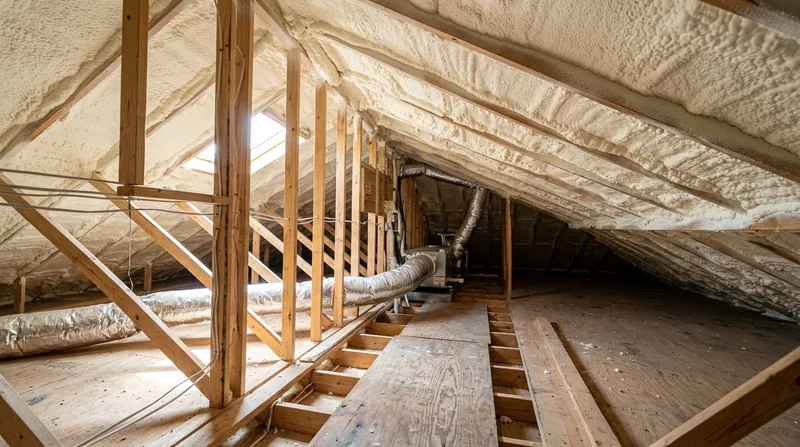




San Antonio's attic spray foam insulation problem is not about winter cold. It is about summer heat and humidity working against your air conditioning system from above. Most homes here sit on slab-on-grade foundations with vented attics that bake under the long Central Texas summer, pulling humid outside air down through ductwork and into the living spaces below. The older stock in Monte Vista, King William, and Alamo Heights, along with mid-century ranches across Leon Valley and the inner neighborhoods, were built with thin fiberglass insulation that has settled or compacted over decades. Modern subdivisions pushing north toward Stone Oak and Helotes have better insulation but still rely on vented attics that leak energy and moisture. We seal the attic floor and roof deck with spray foam so heat and moisture stay outside the living space, and your HVAC system stops working against the weather.
Why Attic Spray Foam Insulation Matters in San Antonio's Hot, Humid Climate
San Antonio sits in IECC climate zone 2A, hot and humid. Moisture works inward through walls and roof decks for most of the year, not outward. A vented attic pulls humid air up through the living space below whenever the indoor temperature drops below the attic temperature, which happens during air conditioning cycles. That humid air condenses on cool ductwork, reducing HVAC efficiency and driving up cooling costs. Spray foam seals the attic floor and roof deck so the attic stays outside the conditioned envelope, stopping the moisture pull and the energy loss at the same time.
- Vented attics in San Antonio pull humid outside air through the living space during cooling cycles, wasting energy and moisture-loading the interior.
- Settled fiberglass insulation in older homes loses R-value over time and does nothing to stop air leakage.
- Ductwork running through unconditioned attic space loses cooled air to the heat above, forcing the HVAC system to run longer and harder.
- Spray foam seals the attic floor and roof deck in a single application, stopping heat gain and humidity infiltration without ongoing maintenance.
A sealed attic keeps the heat and humidity outside, reduces the load on your cooling system, and protects the living space from the moisture that drives bills and damage in this climate.
Key info: San Antonio's long cooling season and stack effect mean attic sealing is not optional for energy efficiency. Homes in Alamo Heights, Leon Valley, and the older central neighborhoods see the biggest gains because vented attics were the standard when they were built. Check your city or county's building department website to confirm what permits or inspections apply to spray foam work at your address.
How We Seal Your Attic with Spray Foam in San Antonio
The job starts with a walk-through and a written estimate that specifies the R-value, foam thickness, and square footage we are sealing. We identify any moisture, roof leaks, or contamination that must be fixed before foam goes down. If the attic floor is wet or the roof is actively leaking, we walk away. Once the substrate is dry and clean, we seal air leaks at the rim, band joists, ductwork penetrations, and the attic floor perimeter before spraying the main deck. We use closed cell or open cell foam depending on your attic's use and your budget, and we maintain mechanical ventilation and a stated re-entry window of twenty-four to forty-eight hours after the work is done.
- We inspect the attic for moisture, roof leaks, and existing insulation condition, and provide a written estimate with R-value and thickness specifications.
- We seal air leaks at the rim, band joists, ductwork penetrations, and attic floor perimeter using closed cell or open cell foam as appropriate.
- We spray the attic floor or roof deck to the specified thickness in controlled passes, maintaining the manufacturer ratio and drum temperature.
- We provide mechanical ventilation during cure and a re-entry window of twenty-four to forty-eight hours before you return to normal use.
- We help you navigate what permits or inspections apply at your address and coordinate with your local building department.
The entire process is transparent and documented. You get a written estimate before we start, and you know exactly what you are getting and why.
Example: A 1,500 square foot attic in Castle Hills with settled fiberglass and exposed ductwork takes two to three days from estimate to completion. We seal the rim joist and perimeter first, then spray the floor to 5.5 inches closed cell (R-33) or 8 inches open cell (R-26), depending on your moisture and budget priorities. The homeowner stays out of the attic for forty-eight hours while the foam cures, then the space is fully usable.
Attic Spray Foam Insulation Methods and Approaches
| Approach | Description | Best for |
|---|---|---|
| Closed Cell Spray Foam | High-density foam at 2 pounds per cubic foot, R-6.5 per inch, vapor barrier properties, stops air and moisture infiltration. | Sealed roof decks, humid climates, moisture-sensitive attics, maximum R-value in minimum space. |
| Open Cell Spray Foam | Lower-density foam at 0.5 pounds per cubic foot, R-3.5 per inch, breathable, sound dampening, lower cost. | Attic floors in vented spaces, budget-conscious retrofits, sound control, retrofit over existing insulation. |
| Attic Floor Sealing | Spray foam applied to the underside of the attic floor (the ceiling of the living space below), sealing the conditioned envelope. | Vented attics, homes with ductwork in the attic, energy efficiency priority, moisture control. |
| Sealed Roof Deck | Spray foam applied to the underside of the roof sheathing, sealing the attic space itself and creating a conditioned attic. | Attics with HVAC equipment or ducts, finished attic conversions, moisture-sensitive stored items, maximum climate control. |
Each approach has a different cost and performance profile. We help you choose the right one for your attic's condition, your budget, and San Antonio's hot, humid climate.
Attic Spray Foam Insulation Cost in San Antonio: What to Expect
Attic spray foam insulation in San Antonio typically ranges from $1.50 to $2.50 per square foot for labor and materials, depending on whether you choose open cell or closed cell foam, the thickness you need, and the complexity of the attic layout. A 1,500 square foot attic sealed with open cell foam to R-26 runs roughly $2,250 to $3,750. The same attic sealed with closed cell foam to R-33 runs $3,000 to $5,000. These are starting points. Access, the presence of existing insulation or contamination, roof leaks that need fixing, and the number of penetrations all affect the final cost. We provide a written estimate on site that specifies the R-value, thickness, and square footage, so you know exactly what you are paying for before we start.
Do not compare spray foam bids on price alone. A low estimate with no R-value specification, no thickness detail, no mechanical ventilation plan, and a promise of immediate re-entry is a red flag. Get 2 to 3 estimates from contractors who can show you their insurance, explain the cure process, and give you a realistic timeline. Visit our pricing page for a detailed breakdown of service costs and the factors that move the estimate up or down.
What to Look for When Hiring a Spray Foam Insulation Contractor Near San Antonio
Spray foam insulation is a technical trade, and the difference between a good installation and a bad one is not visible until something goes wrong. Ask any contractor you interview for proof of insurance, a written estimate with R-value and thickness specifications, and a clear explanation of the cure process and re-entry timeline. Verify that the contractor can explain why closed cell or open cell foam is right for your attic, and ask for references from homeowners in San Antonio or nearby areas. If the contractor promises immediate re-entry, guarantees energy savings as a dollar amount, or offers a price far below the market range, move on. Check your city or county's contractor registration requirements and confirm that any contractor you hire meets them before work begins.
- Request a written estimate that specifies the R-value, foam thickness in inches, and total square footage to be sealed.
- Ask the contractor to explain the cure process, mechanical ventilation during application, and the re-entry window before the space is usable.
- Verify the contractor is fully insured and ask to see a current certificate of insurance with your address as the job site.
- Get references from at least two homeowners in San Antonio, Leon Valley, or nearby areas and follow up with actual phone calls.
- Ask whether your city or county requires contractor registration and confirm the contractor holds it before you sign an agreement.
The best contractor is the one who answers your questions clearly, provides a detailed estimate, and can explain the trade without pressure or hype. Contact us for a free estimate and we will walk you through the process step by step. Call (830) 429-5826 with any questions.
Attic Spray Foam Insulation in San Antonio: Pricing Guide
| Service | Price | Details |
|---|---|---|
| Open Cell Spray Foam Attic Sealing | Starting at $1.50/sq ft | Lower cost per square foot, R-3.5 per inch, best for vented attics and budget-conscious retrofits in San Antonio |
| Closed Cell Spray Foam Attic Sealing | Starting at $2.00/sq ft | Higher R-value at R-6.5 per inch, vapor barrier properties, sealed roof decks, humidity control in Central Texas climate |
| Attic Air Sealing and Rim Joist Foam | Starting at $800 | Perimeter sealing, ductwork penetrations, band joist work, often combined with main attic floor or roof deck spray |
| Insulation Removal and Replacement | On estimate | Removal of failed or contaminated insulation before spray foam application requires site inspection to assess volume and condition |
| Free Written Estimate | No charge | On-site inspection with R-value and thickness specifications, response within 24 hours, call (830) 429-5826 |
Indicative pricing, the exact cost depends on square footage, finish, and site access. Free personalized estimate within 24h at (830) 429-5826.


