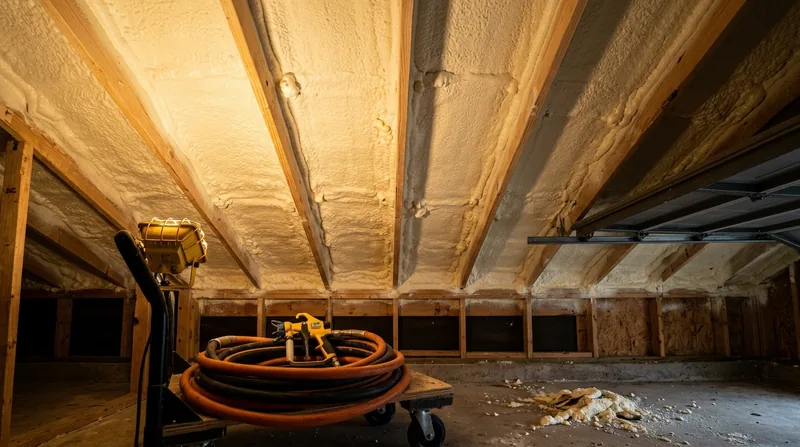




Garage spray foam insulation in San Antonio keeps bonus rooms and living spaces above garages comfortable through the long Central Texas cooling season. West-facing garages absorb intense afternoon heat, and that thermal load radiates up through standard ceiling framing into the rooms above, forcing your air conditioning to work harder and longer. Spray foam seals the garage ceiling and shared walls with a continuous air barrier and high R-value insulation, stopping the heat transfer before it reaches your living space. Most San Antonio homes sit on slab-on-grade foundations with garages tucked underneath or beside bonus rooms, creating a direct thermal path that fiberglass batts and blown-in cellulose cannot fully seal. We foam the boundary between conditioned space and the unconditioned garage, then air-seal the perimeter so your HVAC system cools the rooms you use, not the space where you park. Call us at (830) 429-5826 for a free estimate, or visit our pricing page to understand what this work costs in your area.
Why Garage Spray Foam Insulation Matters in San Antonio's Heat and Humidity
San Antonio's cooling season runs long and hard. Summer temperatures routinely exceed 95 degrees, and the humidity that moves inland from the Gulf keeps your HVAC system running day and night. Garages, especially those facing west or southwest, become thermal ovens by mid-afternoon. The concrete floor and metal door absorb and radiate heat, and that energy conducts straight up through standard wood-frame ceilings into the rooms above. A bonus room or bedroom above a garage can run 8 to 12 degrees warmer than the same room on the other side of the house, even with the thermostat set the same. Spray foam blocks this heat transfer completely.
- We seal the entire garage ceiling with closed-cell or open-cell foam to create a continuous thermal and air barrier.
- We foam the shared walls between the garage and conditioned space so heat does not conduct through the framing.
- We air-seal rim joists, band joists, and wall penetrations so conditioned air does not leak into the garage.
- We remove old, settled, or damaged insulation and replace it with foam that will not compress or fail over time.
The result is a bonus room or guest bedroom that stays cool in summer without the thermostat fighting the heat load from below.
Key info: A bonus room above a garage in Leon Valley or Terrell Hills that stays 10 degrees hotter than the rest of the house is not a thermostat problem. It is a thermal boundary problem. Spray foam fixes the boundary. Standard insulation does not.
For more on how air sealing works hand-in-hand with insulation, visit our air sealing page.
How We Insulate Garage Ceilings and Shared Walls in San Antonio
The job starts with a site visit and a written estimate that spells out R-value, foam thickness, and the square footage we will cover. We identify the garage ceiling framing, the shared wall cavities, and any rim or band joists that leak air. We assess whether the existing attic space above the garage is vented or sealed, and whether we need to tie the garage foam into the attic insulation system. We then schedule the work for a day when you can stay out of the garage for 24 to 48 hours while the foam cures and off-gasses. On the day of the job, we set up mechanical ventilation in the garage, spray the foam to the specified thickness in even passes, and allow the material to cure fully before we leave. You can re-enter the space after the cure window, and the room above will feel the difference within hours.
- We remove any existing insulation, debris, or contamination from the ceiling framing so the foam bonds to clean wood.
- We spray closed-cell foam for maximum R-value and moisture resistance, or open-cell foam if budget is a priority.
- We foam the shared wall cavities between the garage and the bonus room to seal thermal bridging through the studs.
- We air-seal the rim joist and band joist where the garage wall meets the foundation.
- We provide mechanical ventilation during cure and a clear re-entry timeline so you know when the space is safe to use.
Once the foam cures, the garage ceiling becomes a solid insulation and air barrier that requires no maintenance and will not settle, compress, or absorb moisture.
Real example: A homeowner in Castle Hills had a master bedroom above an attached two-car garage. The room was always hot, and the AC ran constantly. We foamed the garage ceiling to 5.5 inches of closed-cell foam (R-39) and sealed the shared wall cavities. The room temperature dropped 8 degrees within the first week of summer, and the homeowner's cooling bills fell noticeably. No additional HVAC work was needed.
For details on how open-cell and closed-cell foam perform in different situations, see our closed-cell spray foam page.
Garage Spray Foam Insulation Methods and Approaches
| Approach | Description | Best for |
|---|---|---|
| Closed-Cell Foam | High-density foam with tightly packed cells, R-value 6.0 to 6.5 per inch, moisture-resistant, vapor-closed. | Garages where moisture from the ground or humidity may be present, maximum R-value in minimal thickness, and where you want the longest service life. |
| Open-Cell Foam | Lower-density foam with open cell structure, R-value 3.5 to 3.8 per inch, vapor-permeable, lighter cost. | Garages in dry climates where budget is a concern and you do not need maximum density, or where vapor permeability is an advantage. |
| Ceiling-Only Foam | Foam applied only to the garage ceiling, typically 4 to 6 inches, sealing the primary thermal boundary. | Bonus rooms or bedrooms directly above the garage where the ceiling is the main heat source and walls are already insulated. |
| Ceiling and Wall Foam | Foam applied to the ceiling and the shared interior walls, creating a complete thermal envelope around the garage. | Rooms above or adjacent to the garage where the shared wall is also conducting heat, or where air sealing the entire boundary is the priority. |
Garage Spray Foam Insulation Cost in San Antonio: What to Expect
Garage spray foam insulation in San Antonio typically starts at $1,200 for a small single-car garage ceiling with open-cell foam, and ranges from $1,500 to $3,500 for a two-car garage with closed-cell foam and shared wall coverage. The final price depends on the square footage of the ceiling, the type of foam you choose, the thickness needed to reach your target R-value, and whether you are sealing walls and rim joists in addition to the ceiling. Access also matters: if the attic above the garage is cramped or cluttered, the crew needs more time to set up and spray safely. A garage ceiling measuring 400 to 500 square feet typically costs between $1,800 and $2,500 with closed-cell foam at 5 to 6 inches. If you add the shared wall cavities, add another $300 to $600. We provide a written estimate with the exact R-value, thickness, and square footage, so you know what you are paying for before we start.
Getting two or three estimates from different contractors is smart. You will see a range of prices and approaches, and you can ask each contractor to explain why their method costs more or less. Avoid any estimate that does not specify R-value and thickness, or that promises immediate re-entry after the spray. Those are red flags for rushed or substandard work. For a full breakdown of our pricing structure and what drives costs up or down, visit our pricing page.
What to Look for When Hiring a Garage Spray Foam Insulation Contractor Near San Antonio
Spray foam insulation is a specialized trade, and the quality of the installation depends entirely on the crew and their attention to detail. When you call a contractor, ask them to provide a written estimate with R-value and thickness spelled out. Ask whether they use mechanical ventilation during the spray and cure phases, and what re-entry window they recommend. Ask for references from recent garage insulation jobs in your area, and call those homeowners to ask if the work was clean, the crew was professional, and the room above the garage is actually cooler now. Ask whether they are fully insured and ask to see a current certificate of insurance. In San Antonio and the surrounding cities, contractor registration requirements vary by municipality, so ask any contractor whether your city or county requires registration before pulling a permit, and ask to see proof of that registration. Do not hire based on price alone. The cheapest estimate is often the fastest, least thorough job. The most expensive is not always the best. The middle estimate from a contractor who listens, asks questions, and provides a detailed scope is usually the safest bet. Call us at (830) 429-5826 to discuss your garage insulation project, or visit our contact page to request a free estimate.
When you are ready to move forward, we will schedule a site visit, provide a written estimate with all specs, and answer every question before we spray a single board foot of foam.
Garage Spray Foam Insulation in San Antonio: Pricing Guide
| Service | Price | Details |
|---|---|---|
| Single-car garage ceiling, open-cell foam | Starting at $1,200 | Approximately 250 to 300 square feet, 4 to 5 inches of open-cell foam, ceiling only, no wall coverage |
| Two-car garage ceiling, closed-cell foam | Starting at $1,800 | Approximately 400 to 500 square feet, 5 to 6 inches of closed-cell foam, ceiling only, maximum R-value and moisture resistance |
| Two-car garage with shared wall insulation | Starting at $2,200 | Garage ceiling plus interior shared walls between garage and bonus room, closed-cell foam, complete thermal boundary sealing |
| Garage with attic tie-in and rim joist sealing | Starting at $2,500 | Ceiling, walls, rim joists, and connection to attic insulation system for homes with vented or sealed attics above |
| Travel and site evaluation | Included | No mileage fees or travel charges in San Antonio and surrounding service areas within Bexar County |
| Free written estimate | Free | Response within 24 hours at (830) 429-5826, includes R-value, thickness, square footage, and no obligation to book |
Indicative pricing, the exact cost depends on square footage, finish, and site access. Free personalized estimate within 24h at (830) 429-5826.


